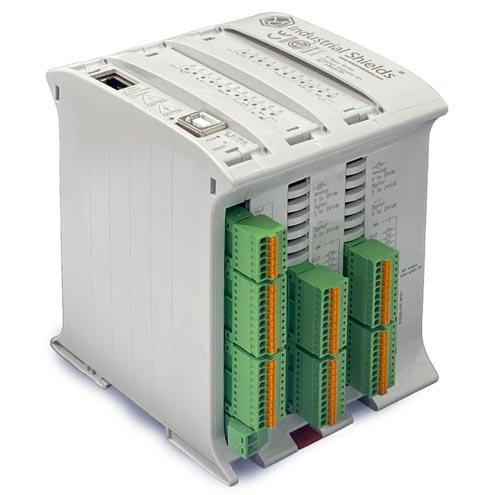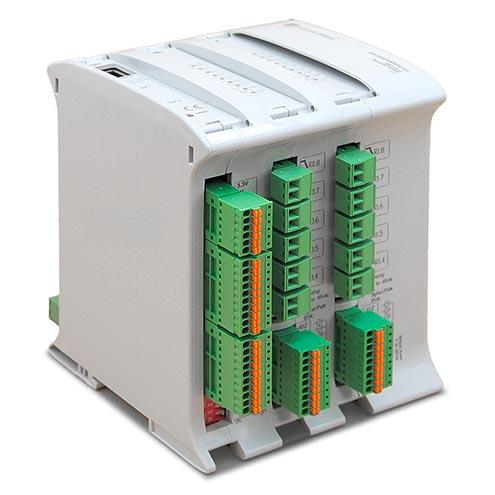
Arduino PLC: A Practical Guide for Industrial Automation
This guide explains the Arduino PLC concept in a practical way: when it makes sense, what to check before choosing, typical use cases, and a quick copy/paste selection checklist.

Arduino PLC is a practical way to keep Arduino’s development speed while moving closer to real industrial control-panel requirements. In other words, you can iterate quickly during prototyping and still simplify field deployment with typical needs such as 12–24V power, DIN-rail mounting, structured wiring, and robust communications.
Below, we break down what an Arduino PLC is, how it differs from a classic PLC, what to look for before selecting hardware, and how to validate your I/O and comms plan.
What Is an Arduino PLC?
In most discussions, the term “Arduino PLC” refers to an industrial-oriented controller that:
- supports an Arduino-friendly development workflow,
- is I/O-focused (digital/analog inputs and outputs), and
- is designed for panel installation practices (mounting, power, wiring, and communications).
The goal is simple: bring the prototype into the real world without losing agility.
Arduino PLC vs Classic PLC: Where’s the Real Difference?
This is not a “which is better” debate. Instead, it’s about choosing the right architecture for your project constraints and maintenance realities.
24V power and DIN-rail mounting
Industrial panels typically standardize on 12–24V DC power and DIN-rail mounting. While dev boards can be adapted, an industrial form factor usually reduces commissioning friction and improves maintainability.
Communications: RS-485/Modbus, Ethernet, and more
Field devices often rely on stable communications (drives, meters, remote I/O, gateways). Therefore, controller selection should start with the question: “Which protocols and ports do we actually need?”
Commissioning and serviceability
It’s not only about code. Clear wiring, labeling, replaceability, and predictable panel practices matter for years. As a result, the “best” controller is the one your team can deploy and service reliably.
Tip: First define your I/O and communications requirements. Then choose the platform that matches your electrical, mechanical, and support constraints.
Industrial Arduino PLC Selection Criteria
Use these items as a “must-check” list in your project documentation.
Arduino PLC I/O count and expansion plan
How many DI/DO/AI/AO do you need today—and what changes in 6–12 months? A clear I/O plan reduces cost and speeds up commissioning.
- Sensor types (PNP/NPN, analog ranges)
- Output types (relay vs transistor)
- Safety circuits (often require a separate safety architecture)
Arduino PLC panel wiring, EMI/noise, and installation practices
Electrical noise, grounding, terminal organization, and heat are “hidden costs” in industrial panels. Consequently, a controller designed for panel practice can make installation more straightforward.
Software workflow: Arduino IDE and PLC IDE options
Depending on the platform, development options differ:
- Some industrial Arduino controllers keep an Arduino-style workflow.
- Some ecosystems offer IEC 61131-3 languages via a PLC IDE approach (platform-dependent).
Arduino PLC Use Cases
Production line automation
Production lines typically combine process control, station-to-station coordination, and monitoring/reporting. For this reason, I/O mapping and communications design are often the deciding factors.
Energy monitoring / solar monitoring
Energy and solar applications often require reliable data acquisition, secure transfer from field to dashboard, and basic automation routines. In addition, stable connectivity and maintainable wiring are key for long-term operation.
How to Move Forward (Support)
A simple, repeatable way to accelerate your Arduino PLC project:
- Document your signal list and create an I/O map
- Confirm communications needs (RS-485/Modbus/Ethernet, etc.)
- Select the controller family based on panel constraints and scaling
- Plan the path from pilot to repeatable deployment
Internal links (update to match your site structure):
• Industrial Arduino PLC
• Industrial Shields
• Contact
Quick Arduino PLC Selection Checklist (Copy/Paste)
- Power: Do you require 12–24V DC inside the panel?
- Mounting: Is DIN-rail mandatory?
- I/O: DI/DO/AI/AO counts now and in 12 months?
- Comms: RS-485/Modbus? Ethernet? Other interfaces?
- Timing: What response/cycle requirements does the machine need?
- Environment: EMI/noise, grounding, temperature expectations
- Maintenance: Who will service it, and what tooling do they prefer?
- Software: Arduino-style workflow or IEC languages?
- Documentation: wiring diagram, tags, and test plan ready?
- Scale: One-off machine or repeated OEM design?
FAQ
What is an Arduino PLC?
An Arduino PLC is typically an Arduino-friendly controller approach designed for industrial panel practices—power, mounting, wiring, I/O, and communications.
Can an Arduino PLC be used with 24V industrial sensors and actuators?
Yes—when the hardware and I/O interface are designed for industrial wiring and power practices. Always validate your signal list and wiring method early.
Can I program an Arduino PLC using Arduino IDE?
It depends on the platform. Confirm which development environments are officially supported for the controller family you select.
When should I choose a classic PLC instead?
If your site requires a specific vendor ecosystem, strict plant standards, regulated safety requirements, or long-established maintenance workflows, a classic PLC may be the right choice. Sometimes a hybrid architecture also makes sense.
Where can I get local support?
Use your local distributor/partner or your internal automation integrator—ideally someone who can validate I/O, comms, and panel practices end-to-end.
Share your scenario—get a quick I/O + comms mapping
Send your machine type, approximate I/O count, and required communications (RS-485/Modbus/Ethernet). We’ll reply with a short “controller + I/O mapping” suggestion and recommended next steps.
- Arduino PLC IDE (IEC 61131-3): Official Arduino page
- Arduino PLC IDE documentation: Arduino Docs
- Industrial Shields case study (automotive production line): Case Study
- Industrial Shields case study (solar panel monitoring): Case Study