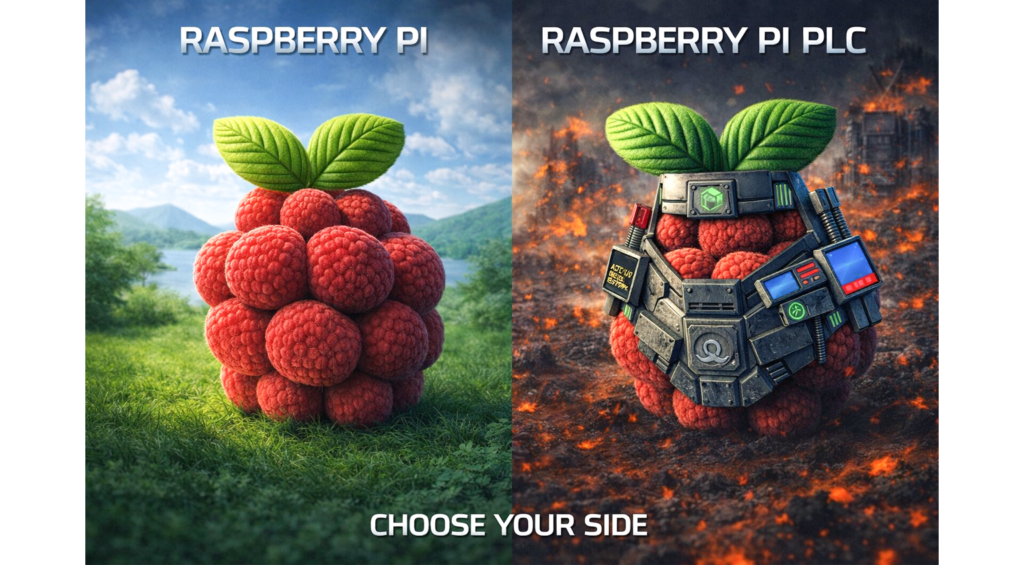
What Is a Raspberry Pi PLC?
One of the most common questions in industrial automation is: “What is a Raspberry Pi PLC?”
A Raspberry Pi PLC is an industrial controller developed using Raspberry Pi technology (most commonly based on Raspberry Pi Compute Module designs) and engineered to operate reliably in industrial environments.
Unlike a standard Raspberry Pi, Raspberry Pi PLCs are typically:
- Suitable for control cabinet and panel mounting (DIN rail / panel)
- Equipped with industrial input/output (I/O) interfaces (model/vendor dependent)
- Designed to work with industrial signals such as 24V field wiring
- Built for long-term and continuous operation
For these reasons, Raspberry Pi PLCs are commonly used in industrial automation, machine control, and monitoring applications.
What Is a Standard Raspberry Pi?
A standard Raspberry Pi is a single-board computer (SBC) capable of running Linux-based operating systems. It is widely used for:
- Education and technical learning
- Prototyping and proof-of-concept projects
- Maker and hobby applications
- Basic IoT and edge computing tasks
However, one important fact must be clearly stated:
A standard Raspberry Pi is not an industrial PLC.
To be used in industrial environments, additional engineering is required for enclosure design, industrial wiring, electrical isolation, EMC resistance, and 24V I/O integration.
Can You Build a PLC Using Raspberry Pi?
A frequently searched question is: “Can a Raspberry Pi be used as a PLC?”
Technically, yes. In practice, however, most projects require additional components such as:
- External digital and analog I/O boards
- Relay interfaces and 24V signal conditioning
- Industrial power supplies, protection, and enclosures
- Panel mounting and field wiring solutions
These additions increase time, cost, and risk, especially in production environments. This is why many teams prefer using a Raspberry Pi PLC instead of building everything from scratch.
Soft PLC, CODESYS, and Raspberry Pi
Search terms like “Soft PLC Raspberry Pi” or “CODESYS Raspberry Pi” are becoming more common.
These concepts refer to implementing PLC logic through software. However, a critical point remains:
Software alone does not make a PLC.
Industrial reliability also depends on industrial-grade hardware. For this reason, Soft PLC approaches are far more reliable when deployed on industrial Raspberry Pi PLC hardware.
Raspberry Pi 5, Price, and Industrial Reality
Many users search for “Raspberry Pi 5” or “Raspberry Pi price”. While performance and board cost matter, industrial automation decisions should also consider:
- Total cost of ownership
- Integration time
- Maintenance and failure risk
- Downtime cost
A standard Raspberry Pi may appear inexpensive at first, but the additional hardware and engineering required for industrial use can significantly increase overall project cost.
Raspberry Pi vs Raspberry Pi PLC – Comparison Table
| Category | Raspberry Pi | Raspberry Pi PLC |
|---|---|---|
| Main purpose | Education, prototyping, development | Industrial automation and control |
| Industrial readiness | Requires additional design | Designed for industrial use |
| I/O structure | GPIO (external interfaces required) | Integrated industrial I/O (model dependent) |
| 24V field signals | Not directly supported | Designed to support industrial signals |
| DIN rail / panel mounting | No | Yes (typically) |
| Continuous operation | Environment dependent | Designed for long-term operation |
| Typical users | Students, makers, developers | OEMs, system integrators, industrial teams |
Note: I/O count, voltage ranges, protocols, and certifications vary by manufacturer and model. Always check the official datasheet before selecting a device.
Where Are Raspberry Pi PLCs Used?
- Machine and process automation
- Industrial monitoring and data acquisition
- Energy and building automation
- Industry 4.0 projects
Which One Should You Choose?
Choose Raspberry Pi if:
- You are in the education or prototyping phase
- The environment is controlled (office/lab)
- You want full control over hardware integration
Choose Raspberry Pi PLC if:
- The project will be deployed in production
- Control cabinet mounting and industrial wiring are required
- 24/7 reliable operation is expected
Conclusion
- Raspberry Pi ≠ PLC
- Raspberry Pi PLC is designed for industrial requirements
- Choosing the right platform is critical when moving from prototype to production
FAQ – Raspberry Pi PLC and Raspberry Pi
1) What is a Raspberry Pi PLC?
A Raspberry Pi PLC is an industrial controller built on Raspberry Pi technology, offering panel mounting and industrial I/O that differentiate it from a standard Raspberry Pi.
2) Are Raspberry Pi and Raspberry Pi PLC the same?
No. Raspberry Pi is a single-board computer, while Raspberry Pi PLC is designed specifically for industrial automation.
3) Can Raspberry Pi be used in industrial automation?
Yes, but additional engineering is required for power supply, enclosure, electrical protection, EMC, and 24V I/O integration.
4) Can a Raspberry Pi be turned into a PLC?
Technically yes, but external I/O, isolation, industrial power, and panel mounting are required. Raspberry Pi PLC solutions reduce these integration risks.
5) Why is integrated I/O important?
Industrial systems commonly use 24V signals, analog inputs, and relays. Standard GPIO pins require interface circuits, while Raspberry Pi PLCs typically integrate these features.
6) What is Soft PLC and can it run on Raspberry Pi?
Soft PLC refers to implementing PLC logic via software. It can run on Raspberry Pi, but industrial-grade hardware is essential for reliability.
7) Is Raspberry Pi 5 suitable for industrial use?
Performance alone is not enough. Power, isolation, mounting, I/O safety, and maintenance requirements must also be considered.
8) Why choose a Raspberry Pi PLC instead of a standard Raspberry Pi?
Because industrial projects prioritize total cost of ownership, reliability, and reduced integration risk—not just board price.
9) What should I check when selecting a Raspberry Pi PLC?
Check I/O types and counts, supported voltages, isolation and protection, mounting options, operating temperature, protocol support, and certifications.
CTA
Not sure whether Raspberry Pi or Raspberry Pi PLC is the right choice for your industrial project?
Barnar Global helps you select the right Raspberry Pi PLC architecture for your application.
Email: sales@barnarglobal.com